
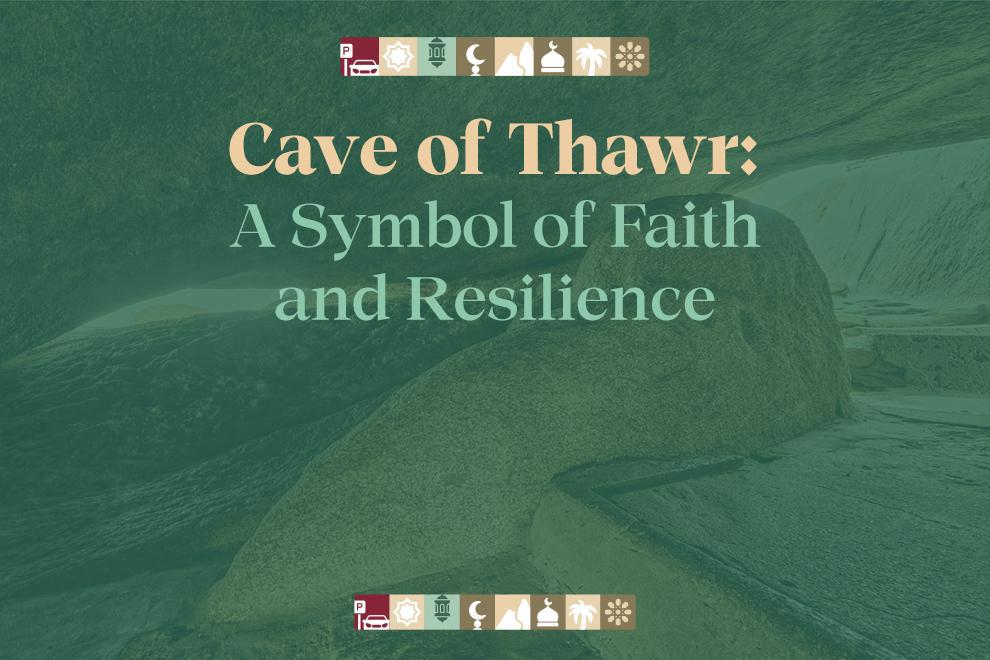
The Cave of Thawr (Ghar Thawr) holds a grand stature in Islamic history, serving as a timeless symbol of faith, resilience, and divine protection. Situated in the rugged terrain of Makkah al-Mukarramah, this cave played a pivotal role during the Migration (Hijrah) of Prophet Muhammad ﷺ and his companion, Abū Bakr al-Siddīq (may Allah be pleased with him). In this article, we delve into the history and significance of the Cave of Thawr, addressing common questions regarding this blessed site.
What is the Cave of Thawr?
The Cave of Thawr is a small cave located near the summit of Mount Thawr (Jabal Thawr), south of Makkah al-Mukarramah. Unlike the Cave of Hira, which is associated with the initial descent of Divine Revelation (Wahy), the Cave of Thawr is famous for its role in sheltering the Prophet ﷺ and his companion Abū Bakr during their migration to Al-Madīnah al-Munawwarah.
The mountain rises 760 meters above sea level; it features gentle slopes at its base but becomes steep and rugged toward the top, presenting a challenging climb. Despite its difficulty, pilgrims, Umrah performers, and visitors ascend the mountain to behold this historical sanctuary.
This cave served as a refuge for the Prophet ﷺ and his companion for three nights, where they hid from the tribesmen of Quraysh who were determined to capture them.
Why Did the Prophet Go to the Cave of Thawr? | Events of the Cave
The Prophet’s journey to the Cave of Thawr occurred at a critical juncture in Islamic history: the Migration to Al-Madīnah. Quraysh was plotting to assassinate him, and Allah Almighty commanded him to leave Makkah with Abū Bakr. The Prophet ﷺ chose the Cave of Thawr as a strategic refuge to evade Quraysh’s pursuit.
Upon reaching the cave, the noble companion Abū Bakr al-Siddīq (may Allah be pleased with him) entered first to inspect and secure it, ensuring it was free from venomous creatures and insects. Once assured of its safety, he invited the Prophet ﷺ to enter, and both stayed in that desolate cave for three nights.
Choosing the Cave of Thawr was a tactical masterclass, as it lies south of Makkah—the exact opposite direction of the northern route to Al-Madīnah—thereby misleading Quraysh's trackers.
The Meticulous Plan
Information Gathering: Abū Bakr instructed his son, 'Abdullāh, to spend the day listening to the news and plots of Quraysh in Makkah and bring them report by nightfall.
Covering Tracks & Sustenance: He ordered his freed slave, 'Āmir ibn Fuhayrah, to graze his sheep nearby during the day and bring them to the cave at night. This provided the Prophet ﷺ and Abū Bakr with fresh milk while the flock simultaneously trampled over and erased 'Abdullāh's footprints.
Quraysh's Pursuit and the Divine Intervention
When Quraysh realized the Prophet ﷺ had departed, panic and rage ensued. They deployed search parties and set up outposts along every trail. Regarding their plot, Allah revealed:
“And [remember, O Muhammad], when those who disbelieved plotted against you to restrain you or kill you or evict you. But they plan, and Allah plans. And Allah is the best of planners.” (Al-Anfāl 8:30)
The pursuers tracked their steps up to the vicinity of the cave. Suspicion arose among them that Muhammad ﷺ and his companion might be hiding inside. A shepherd was nearby, so they asked him: "Have you seen Muhammad and Abū Bakr? Do you know where they went?" The shepherd replied: "Perhaps they are in the cave... though I have not seen anyone head that way."
Inside the cave, the Prophet ﷺ and Abū Bakr could hear the footsteps and voices of the polytheists approaching. Anxiety gripped Abū Bakr (may Allah be pleased with him) out of fear for the Prophet's safety, and he whispered:
"O Messenger of Allah, if one of them were to look down under his feet, he would see us!"
The Prophet ﷺ reassured him with unwavering faith in Allah’s protection:
“O Abū Bakr, what do you think of two, of whom Allah is the third? Do not grieve; indeed, Allah is with us.” (Sahīh al-Bukhārī & Sahīh Muslim)
One of the polytheists approached the cave and looked around, but quickly turned back to his companions, convinced the cave was deserted. Thus, Quraysh turned back empty-handed.
Regarding this moment, Allah Almighty revealed:
“If you do not aid the Prophet, Allah has already aided him when those who disbelieved drove him out [of Makkah] as one of two, when they were in the cave and he said to his companion, 'Do not grieve; indeed Allah is with us.' And Allah sent down His tranquility upon him and supported him with soldiers [angels] you did not see and made the word of those who disbelieved the lowest, while the word of Allah is the highest. And Allah is Exalted in Might and Wise.” (At-Tawbah 9:40)
What is the Difference Between the Cave of Thawr and the Cave of Hira?
Though often confused, the two caves mark distinct, monumental chapters in Islamic history:
Cave of Hira (Ghar Hira): Located on Jabal al-Nūr (Mountain of Light), it is where the first divine revelation (Wahy) descended upon Prophet Muhammad ﷺ through Archangel Jibrīl (Gabriel). It symbolizes the beginning of Prophethood.
Cave of Thawr (Ghar Thawr): Located on Mount Thawr, it served as a sanctuary during the Migration (Hijrah). It symbolizes divine protection and strategic planning.
Description of Mount Thawr and the Cave
Mount Thawr possesses unique geographical characteristics. Reaching its peak leads to the slope of an adjacent mountain structure, making the climb feel as though one is ascending two mountains rather than one, requiring double the effort compared to ascending Jabal al-Nūr.
The cave itself is a hollowed rock structure forming a natural dome, spacious enough inside to accommodate around thirty people. Its entrance is narrow, requiring visitors to crawl on their hands and knees, with a low ceiling measuring around 1.5 meters in height. Facing the main entry, there is a secondary wider opening about twice the size of the entrance.
The cave stands on the northern side near the peak of Mount Thawr (historically known as Jabal Athhal), south of Makkah in the valley of Al-Mufajjar.
Why Was It Named "Thawr"?
The name "Thawr" comes from the mountain on which the cave is situated: Jabal Thawr. Historical accounts suggest it was named after a local figure named Thawr ibn 'Abd Manāf, while other narratives suggest the name was inspired by the mountain's shape, which resembles a bull (Thawr in Arabic).
The Miracle of the Cave of Thawr
The events at the Cave of Thawr stand as prominent miracles (Mu'jizāt) in Islamic history. According to historical traditions, a spider spun its web across the entrance and doves nested at the mouth of the cave, convincing Quraysh that the site was uninhabited and abandoned.
Another profound lesson lies in the Prophet’s calm composure when Abū Bakr expressed fear. The statement: “Do not grieve; indeed Allah is with us” remains an enduring lesson in complete trust in Allah (Tawakkul) for believers across all generations.
Who Aided the Prophet at the Cave of Thawr?
Several key figures played essential roles during the three-day stay at the cave:
Abū Bakr al-Siddīq: Accompanied and guarded the Prophet ﷺ.
Asmā' bint Abī Bakr: Risked her life to transport food and supplies to the cave (earning the title Dhāt al-Nitāqayn - She of the Two Belts).
'Abdullāh ibn Abī Bakr: Gathered intelligence and news regarding Quraysh’s plots.
'Āmir ibn Fuhayrah: Grazed the sheep to supply milk and obscure footsteps.
'Abdullāh ibn Urayqit: A skilled non-Muslim desert guide hired to lead them through unfrequented coastal routes to Al-Madīnah.
Conclusion
The Cave of Thawr is not merely a rock shelter; it is a testament to the power of faith, divine protection, and absolute trust in Allah. Its narrative continues to inspire millions of Muslims worldwide, serving as a reminder of the steadfastness of Prophet Muhammad ﷺ and Abū Bakr during one of the most critical moments in Islamic history.