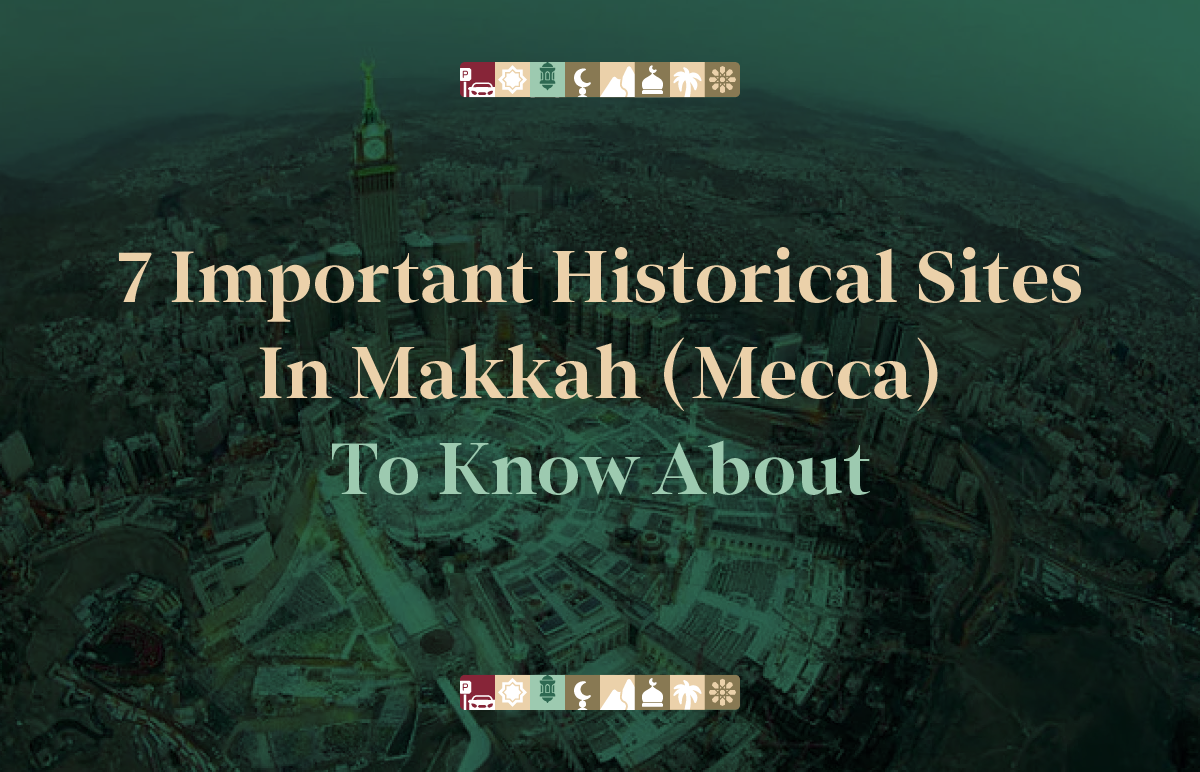
Makkah, the Holy City of Mecca, is a place of huge spiritual significance and historical importance for Muslims around the world. Known as Makkah Al-Mukarramah or the Kaaba City, this sacred city is steeped in Islamic history and traditions. Millions of Muslims visit Makkah annually to perform the Hajj and Umrah, engaging in various religious practices and devotional acts. Here, we cover 7 of the most notable sites in Mecca with historical significance.
1- Al-Masjid Al-Haram
The Great Mosque of Makkah, or Al-Masjid Al-Haram, is the holiest mosque in Islam. This magnificent mosque is the focal point of Makkah and the primary destination for Muslims during Hajj and Umrah. The vast Grand Mosque can accommodate up to 3 million worshippers. At its center lies the Kaaba, draped in black silk embroidered with gold. Pilgrims perform the Tawaf, circumambulating the Kaaba seven times, symbolizing their unity and devotion to Allah.
The Prophet Muhammad (PBUH) referred to Al-Masjid Al-Haram as the most sacred place on Earth. It is here that Muslims perform the five daily prayers facing the Kaaba, emphasizing its central role in Islamic worship. The Quran mentions Al-Masjid Al-Haram multiple times, highlighting its significance in Islamic teachings and history. “Wherever you are ˹O Prophet˺, turn your face towards the Sacred Mosque. This is certainly the truth from your Lord. And Allah is never unaware of what you ˹all˺ do.” (Surah Al-Baqarah: 149)
2- The Kaaba
The Kaaba, the House of Allah, stands as the most sacred site in Islam. According to our Islamic tradition, it was built by Prophet Ibrahim (Abraham) and his son Ismail (Ishmael) as a house of monotheistic worship. The structure, originally a simple rectangular building, is now a cube-shaped edifice covered with the Kiswa, a black silk cloth embroidered with verses from the Quran.
The Kaaba symbolizes the unity of Muslims worldwide, who face its direction during prayers. Prayers offered in the direction of the Kaaba are directly received by Allah. The Quran states, “Indeed, the first House [of worship] established for mankind was that at Makkah - blessed and a guidance for the worlds” (Surah Ali 'Imran: 96). And it’s characterized by The Black Stone (Hajr Al-Aswad), which is embedded in the eastern corner of the Kaaba and is either kissed or touched by pilgrims during Tawaf.
3- Mount Arafat
Mount Arafat, also known as Jabal Al-Rahma, is a granite hill located about 20 kilometers east of central Makkah. This site is of paramount importance during Hajj, as it is the location where the Prophet Muhammad (PBUH) delivered his Farewell Sermon. And about which he says: “Hajj is Arafat.” Pilgrims spend the 9th day of Dhu al-Hijjah in prayer and supplication, on Mount Arafat, seeking forgiveness and mercy from Allah.
4- Muzdalifah
Muzdalifah is an open, level area near Makkah where pilgrims spend the night after the day spent at Arafat. It lies between Mina and Mount Arafat. Pilgrims gather here to collect pebbles for the ritual of Rami, which involves throwing stones at the three Jamarat in Mina. Symbolizing the rejection of evil, reminiscent of Prophet Ibrahim’s (Abraham’s) defiance of Satan. Muzdalifah is mentioned in the Quran: “But when you depart from Arafat, remember Allah at al-Mash'ar al-Haram. And remember Him, as He has guided you, for indeed, you were before that among those astray” (Surah Al-Baqarah: 198). The night spent in Muzdalifah is dedicated to prayer and rest, preparing pilgrims for the next day's rituals.
5- Safa and Marwah
Safa and Marwah are two small hills situated within the Masjid Al-Haram. Pilgrims perform the Sa'i, which involves walking back and forth seven times between these hills. This ritual commemorates Hagar's desperate search for water for her son, Ismail. The Sa'i is an essential part of both Hajj and Umrah, deeply embedded in Islamic tradition. The Quran mentions Safa and Marwah as symbols of Allah: “Indeed, Safa and Marwa are among the symbols of Allah. So whoever makes Hajj to the House or performs Umrah, there is no blame upon him for walking between them” (Surah Al-Baqarah: 158). The Sa'i ritual is a testament to Hagar's faith and perseverance, serving as a reminder of Allah's mercy.
6- Maqam Ibrahim
Maqam Ibrahim, or the Station of Abraham, is a rock that reportedly bears the imprint of Prophet Ibrahim's (Abraham’s) feet. It is situated within Al-Masjid Al-Haram, near the Kaaba. According to our Islamic religion, this stone was used by Ibrahim as a platform to stand on while building the Kaaba. Pilgrims often pray behind this stone as part of their pilgrimage rites. And the Quran mentions Maqam Ibrahim: “And take, [O believers], from the standing place of Abraham a place of prayer” (Surah Al-Baqarah: 125).
7- Zamzam Well
The Zamzam Well is a miraculous water source located within the Masjid Al-Haram, close to the Kaaba. It sprang forth by Jibreel by God’s welling when Hagar, the wife of Prophet Ibrahim, searched desperately for water for her son Ismail. The water of Zamzam is considered blessed, and pilgrims drink it and often take it back home as a cherished memento of their pilgrimage. Ibn Abbas reported: The Messenger of Allah (PBUH) said, “The best water on the face of the earth is Zamzam water. It is food for nourishment and healing for illness”. (Al-Tabarani). In another hadith, the Prophet Muhammad (PBUH) said, “The water of Zamzam is for whatever it is drunk for.” This hadith underscores the spiritual and physical benefits of Zamzam water. The well is a symbol of Allah's mercy and provision, reminding us of Allah’s protection and care bestowed upon Hagar and Ismail.
These are just a few of Makkah’s historical and religious sites, which not only represent the rich heritage of Islamic history but also serve as a beacon of faith, unity, and devotion for Muslims around the world. Visiting these sacred landmarks offers a profound spiritual experience, deeply rooted in the history of Islam and the life of the Prophet Muhammad (PBUH). And much more to know about the historical sites in Makkah on our App for Android and iOS.. Download it now!